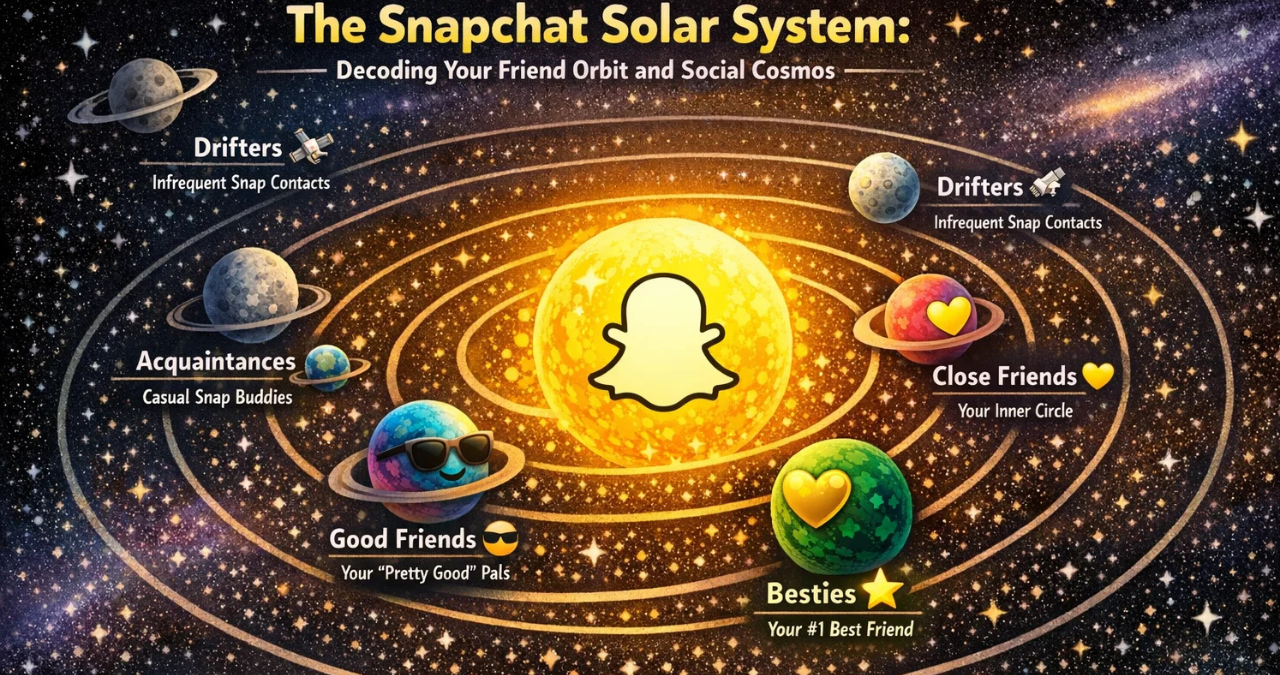
The Snapchat Solar System: Decoding Your Friend Orbit and Social Cosmos
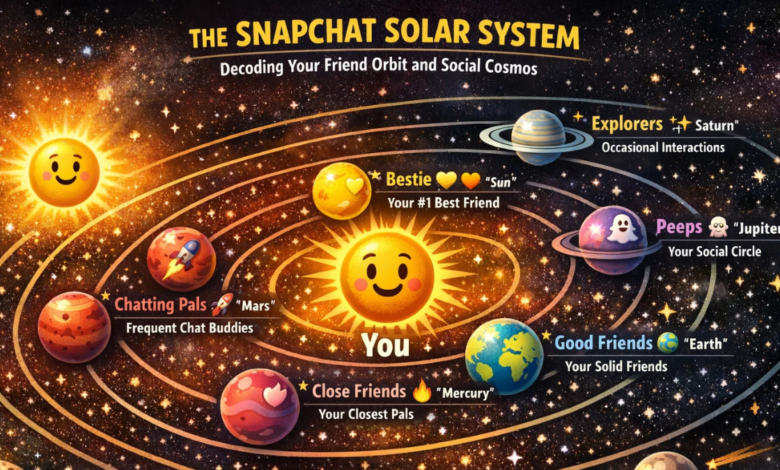
Snapchat Solar System.Imagine opening Snapchat and discovering you’re not just friends with someone you’re orbiting them as a specific planet. This isn’t science fiction; it’s a hidden layer of social analytics within the app that has fascinated, confused, and obsessed users. This feature, universally dubbed the Snapchat solar system, is an opt-in visual representation of your Best Friends list, assigning each of your top eight friends a celestial body based on your interaction frequency.


It transforms abstract data into a personal cosmos, where Mercury signifies your #1 best friend and Neptune represents your #8. More than a quirky graphic, the Snapchat solar system is a window into the app’s core mechanics of reciprocity and engagement, serving as a form of “social astrology” that can validate connections or spark curiosity. This comprehensive guide will be your telescope, exploring every facet of this feature from its astronomical mechanics and psychological impact to strategic considerations and its future in the social media universe. We’ll decode what it truly means to be someone’s Mercury versus their Pluto, and how this hidden cosmos shapes digital relationships.
The Astronomical Mechanics of Friend Rankings
At its core, the Snapchat solar system is a visual metaphor for Snapchat’s proprietary “Best Friends” algorithm. This algorithm is a constantly updating scoreboard of your interaction history. Every snap sent and received, every chat message exchanged, and every story interaction contributes to a hidden point system between you and each of your friends. The system compares these bidirectional interaction scores to create a ranked list. The Snapchat solar system feature, when enabled through Snapchat+, simply maps this list onto a classic eight-planet model, providing a celestial shorthand for your most significant digital relationships. It’s a dynamic universe, not a static one; a week of intense snapping with one friend can see them rocket from Mars to Venus, while another might gradually drift into the outer solar system.
Understanding this requires knowing the specific planetary order. Your #1 Best Friend (the person you interact with most) is assigned Mercury, the planet closest to the sun. The ranking then proceeds outward: Venus is #2, Earth is #3, Mars is #4, Jupiter is #5, Saturn is #6, Uranus is #7, and Neptune is #8. The “sun” in this analogy is you, the user, at the center of your own social universe. It’s crucial to remember that this is a personal perspective; you can be someone’s Mercury while they are your Saturn, revealing the often asymmetrical nature of digital communication. This mechanic underscores that the Snapchat solar system isn’t about absolute popularity, but about relative, pairwise interaction intensity.
Unlocking the Cosmos: Access and Activation
The Snapchat solar system is not a default feature for all users. It is exclusively available as a perk of Snapchat+, the app’s subscription service. This places it behind a paywall, framing it as a premium piece of social insight. To access it, a user must first subscribe to Snapchat+. Once subscribed, the feature must be manually activated. The path is found within the app’s settings: navigate to your profile, tap the Snapchat+ banner, and then find the “Solar System” option under “Friends & Planets” or a similar menu. Toggling it on unlocks the cosmic visuals across your friendship interfaces. This gated access creates a tiered user experience, where subscribers gain a layer of meta-awareness about their interactions that free users do not.
Once activated, the planets reveal themselves in specific locations. The primary place to view your solar system is within the chat screen with a friend who is in your top eight. If they have a planet, a small icon of that planet will appear next to their name in the chat header. Tapping on this planet icon launches a full-screen, animated graphic that beautifully illustrates their planetary position relative to you, complete with educational tidbits about the planet itself. Furthermore, you can view a list of all your planetary friendships from the Snapchat+ management page. This elegant integration makes the data feel less like a spreadsheet and more like a discoverable, engaging game, reinforcing the app’s playful brand identity while delivering potent social feedback.
The Psychology of Planetary Placement
The reveal of one’s planetary status can trigger a profound psychological response, tapping into deep-seated needs for social validation and belonging. Being someone’s Mercury or Venus can feel like a digital badge of honor, a quantifiable proof of closeness that generates a hit of dopamine. It confirms that the feeling of a strong connection is mutual, at least in terms of raw interaction volume. This validation can strengthen bonds and increase sharing, as users feel seen and prioritized within another person’s digital orbit. The feature gamifies intimacy, turning the abstract concept of “best friends” into a tangible, hierarchical system that users can actively “play” to improve their rank.
Conversely, the Snapchat solar system can be a source of significant social anxiety and over-analysis. Finding yourself as someone’s outer planet a Jupiter, Saturn, or Neptune can lead to questions about the relationship’s depth. Friends may compare their planetary positions with each other, leading to potential jealousy or “snap score grinding,” where interaction becomes a strategic effort to climb the planetary ladder rather than organic communication. The asymmetry of placements (you’re their Earth, they’re your Neptune) can cause distress, highlighting the often-uncomfortable truth that our perception of a relationship’s intensity isn’t always mirrored by the other party. As digital anthropologist Dr. Alicia Blum-Ross observes, “Features like the Snapchat solar system externalize the unspoken metrics of friendship, making the implicit explicit and, in doing so, creating new forms of social currency and tension.”
Strategic Navigation and Social Etiquette
Given the potential for social friction, navigating the Snapchat solar system wisely becomes a modern digital skill. The most important rule is to never assume the feature is a perfect measure of real-world friendship. A coworker you snap daily for quick logistics may become your Mercury, while your closest childhood friend you call on the phone might be a Pluto (outside the system entirely). The algorithm measures frequency, not emotional weight. Therefore, it’s generally considered poor form to confront someone about why you are “only” their Mars or to aggressively demand snaps to improve your rank. This turns genuine connection into a transactional chore and misses the point of the feature as a passive insight tool.
A healthier approach is to use the Snapchat solar system as a mirror for your own communication habits, not a weapon for social audit. If you notice a close friend drifting to your outer planets, it might be a gentle, algorithmic nudge to reach out more meaningfully. Conversely, if someone you consider an acquaintance is your Venus, it could indicate they value the connection more than you realized, opening a door for deeper engagement. The power move is to disable the feature if it causes more stress than joy. The ability to opt-out of this social scrutiny is a vital pressure release valve, reminding users that these metrics are optional lenses, not definitive truths about their relationships.
Beyond the Planets: The Broader Best Friends Ecosystem
The Snapchat solar system is merely the most visually striking manifestation of Snapchat’s long-standing obsession with mapping social proximity. It sits within a broader ecosystem of friend-ranking features that have evolved over the app’s history. The classic “Best Friends” list (the three emoji hearts) and the “Friend Emojis” (like the 😊 Smile for a best friend or the 🔥 Fire for a snap streak) are predecessors that established this language. The solar system is essentially a more granular and elaborate extension of this system, offering eight tiers instead of three and replacing emojis with a grand cosmic theme. Understanding this lineage is key to seeing the feature not as an isolated gimmick, but as part of Snapchat’s core identity of quantifying reciprocity.
This ecosystem also includes the recently added “Signs” feature for Snapchat+ subscribers, which assigns zodiac-like signs based on friendship dynamics (e.g., “Fire Sign” for a fast-growing friendship). Together, the Snapchat solar system and Signs create a rich, almost mystical layer of social analytics. They provide narratives—“You are their Mercury, and your bond is a Fire Sign”—that are more engaging than raw numbers. This evolution shows Snapchat’s strategy: transforming cold, hard interaction data into personalized, shareable, and intriguing stories. It keeps users engaged not just by facilitating communication, but by providing constant, evolving feedback about their communication patterns.
Comparative Analysis: Snapchat’s System Versus Other Social Metrics
To fully grasp the uniqueness of the Snapchat solar system, it’s helpful to compare it to other platforms’ attempts at quantifying social bonds. Unlike public metrics like Instagram “Likes” or Twitter “Retweets,” which measure broadcast popularity, Snapchat’s planets measure private, reciprocal communication. The closest analog might be Facebook’s long-gone “Top Friends” list or the algorithmic “Close Friends” list on Instagram Stories, but neither provides the same ranked, granular, and visual feedback.
| Feature / Platform | Metric Type | Visibility | Granularity | User Control |
|---|---|---|---|---|
| Snapchat Solar System | Private, reciprocal interaction frequency | Private (only you see their planet) | High (8 specific ranks) | Can toggle feature on/off |
| Snapchat Best Friends (Hearts) | Private, reciprocal interaction frequency | Private | Low (top 3 friends) | No control over list |
| Instagram Close Friends | User-curated list for story sharing | Semi-private (list is curated, story viewers know they’re on it) | Binary (In or Out of list) | Full user curation |
| Public Likes/Retweets | Public endorsement of content | Fully Public | Volume-based (count) | Can hide like counts on some platforms |
| iMessage / WhatsApp | None; implicit via recency/frequency | N/A | N/A | N/A |
This table highlights the Snapchat solar system’s distinct position: it is an algorithmic, private, and highly granular insight. User control is limited to viewing or hiding it, not manipulating the results, which is what makes it feel like an authentic (and sometimes brutal) reflection of behavior. It’s a metric of effort and attention exchanged, not of public approval, setting it apart in the social media landscape.
The Business of Social Astronomy: Why Snapchat Built This
From a product strategy standpoint, the Snapchat solar system is a masterstroke for driving core business objectives. Firstly, it is a powerful retention tool. The dynamic, ever-shifting nature of the planets creates a “hook” that encourages users to open the app frequently to check their status. The desire to maintain or improve a planetary position with a close friend directly motivates consistent snapping and chatting, increasing daily active users and session time. It turns relationship maintenance into a subtle, ongoing game with visible progress markers, deeply embedding the app into the daily rituals of friendship.
Secondly, and more directly, it is a flagship feature for Snapchat+, making the subscription service tangibly valuable. In a market where premium social media features are often about removing ads or enhancing aesthetics, the Snapchat solar system offers something unique: privileged social intelligence. It answers the innate human curiosity about “where we stand.” This perceived value helps convert free users to subscribers and reduces churn, as turning off Snapchat+ would mean losing access to this intriguing social lens. It monetizes curiosity and social validation directly, proving that users are willing to pay for deeper insights into their own digital interactions.
Potential Pitfalls and User Concerns
For all its intrigue, the Snapchat solar system is not without significant downsides and user concerns. The most prominent issue is its potential to exacerbate teen and young adult social anxiety. Adolescence is a period intensely focused on social standing, inclusion, and peer validation. A feature that numerically ranks your friends can weaponize these insecurities, leading to feelings of exclusion, obsession over rankings, and even cyberbullying where users are teased for being an “outer planet.” It can create a pressure to communicate for the sake of algorithmic scoring rather than genuine connection, distorting natural relationship rhythms.
Furthermore, the algorithm’s opacity is a double-edged sword. Because Snapchat doesn’t reveal the exact formula—what interactions are weighted most heavily, how long the history spans, etc.—users can’t fully understand why they are a certain planet. This lack of transparency can lead to misinterpretation and paranoia. Additionally, the feature can inadvertently reveal private social patterns; if someone notices their planet changes every time you start talking to a new romantic interest, it can signal the status of that relationship before you’re ready to share it. These pitfalls highlight the ethical responsibility Snapchat bears in designing features that quantify human relationships, requiring careful consideration of their impact on vulnerable user bases.
Looking to the Future: Evolution of the Social Cosmos
The Snapchat solar system as it exists today is likely just the first version of a more expansive social analytics suite. We can speculate on several potential evolutions. Snapchat could introduce more celestial bodies, like moons or asteroids, to represent sub-categories within the top eight (e.g., a “moon” for a friend you mostly send memories to, or a “comet” for a friend with a record-long streak). They could develop “constellation” views that visualize the entire network of how your top friends interact with each other, mapping a mini-galaxy of social connections. There’s also potential for more proactive notifications, like “You’ve just become so-and-so’s Venus!” to celebrate climbing the ranks.
Another forward-looking possibility is deeper integration with other Snapchat+ features, like custom story expiration or pinning best friends. Imagine being able to “lock in” a Mercury friend for a week, or receiving a special snap frame when you achieve a mutual planetary alignment (you are each other’s Mercury). The core principle will remain: using playful, visual metaphors to translate complex interaction data into digestible, engaging insights. The Snapchat solar system has proven there’s an appetite for this, and its future iterations will continue to refine the balance between insightful analytics and healthy social engagement, potentially setting a trend for how all social platforms might one day visualize the invisible bonds between us.
Conclusion
The Snapchat solar system is far more than a whimsical animation for subscribers. It is a profound reflection of how digital platforms mediate, measure, and visualize human connection. By transforming cold interaction data into a warm, personalized cosmos of planets, Snapchat has tapped into a fundamental human desire to understand our place in the social universe of those we care about. It serves as both a validation engine and a source of anxiety, a retention tool and a premium product, a game and a mirror. Mastering this feature isn’t about manipulating your way to Mercury on every friend’s list; it’s about understanding its algorithmic language, respecting its limitations as a measure of true friendship, and using its insights—or choosing to ignore them to foster more authentic connections. As social media continues to evolve, the Snapchat solar system stands as a landmark experiment in making the implicit, explicit, reminding us that in the digital age, even our friendships have their own astronomy.
Frequently Asked Questions (FAQ)
What exactly is the Snapchat solar system?
The Snapchat solar system is a hidden, opt-in feature for Snapchat+ subscribers that visually represents your top eight Best Friends as planets orbiting the sun (which is you). Your #1 best friend is Mercury, and the ranking goes out to Neptune for your #8 friend, based on your mutual snap and chat interaction frequency.
How do I see my Snapchat solar system planets?
To see your planets, you must be a Snapchat+ subscriber and have the feature enabled. Go to your profile, tap the Snapchat+ banner, find “Friends & Planets” or “Solar System,” and toggle it on. Once active, open a chat with a friend in your top eight; if they have a planet, its icon will appear next to their name. Tap it to see the full animation.
Can someone see if they are a planet in my Snapchat solar system?
No, this is a critical privacy aspect. The Snapchat solar system is only visible to you. Your friends cannot see what planet they are in your personal cosmos, and you cannot see what planet you are in theirs unless they physically show you their screen. The insight is purely personal and one-way.
Why am I a different planet in different friends’ solar systems?
This is perfectly normal and highlights the feature’s personal nature. Your planetary position is determined by your unique, pairwise interaction history with each friend. You might be the person Friend A snaps most (their Mercury), but only the 5th-most active contact for Friend B (their Jupiter). The Snapchat solar system reflects these individual relationship dynamics.
Can I turn off the Snapchat solar system feature if I find it stressful?
Absolutely, and this is a recommended strategy if the feature causes anxiety. As a Snapchat+ subscriber, you maintain full control. Simply navigate back to the Snapchat+ management page, find the Solar System setting, and toggle it off. The planetary icons will disappear, allowing you to interact without the ranking being visually present.
You may also read
The Ultimate Guide to Finding the Best Digital Marketing Agency Near me