The Mighty Heart of Machines: Unveiling the Power of the Hydraulic Pump
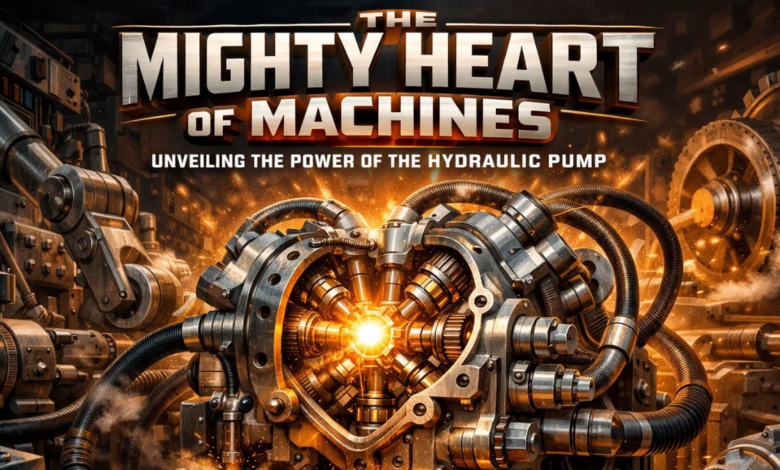
Hydraulic Pump.Imagine trying to lift a car with your bare hands. Sounds impossible, right? Now, imagine using a small lever and a mysterious fluid to hoist that same car into the air with barely any effort. That, in a nutshell, is the magic of hydraulics, and at the very center of this power lies a remarkable device: the Hydraulic Pump. This article is your friendly guide to understanding this engineering marvel.
We’ll break down how it works, explore its different types, and discover why it’s absolutely essential in our modern world. From the gentle sway of a garbage truck’s compactor to the powerful, steady motion of a construction crane, the Hydraulic Pump is the unsung hero, the mighty heart that brings immense power to life.


Think of it this way: if the hydraulic system is the body’s circulatory system, providing strength and motion to limbs, then the Hydraulic Pump is the heart. Its sole job is to get things moving. It doesn’t create pressure out of thin air instead, it creates flow. This flow, when resisted, builds up the tremendous force that does the heavy lifting, pushing, and turning we see on job sites and in factories everywhere. Without this crucial component, the entire system is just a collection of empty hoses and metal parts. Let’s dive in and see what makes this pump tick.
What is a Hydraulic Pump, Really?
In the simplest terms, a Hydraulic Pump is a mechanical device that converts mechanical power—usually from an electric motor, a diesel engine, or even a person’s arm into hydraulic energy. It does this by moving a special fluid from one place to another. It’s a translator of power. The pump takes the rotating, spinning force from an engine and translates it into a smooth, powerful flow of fluid. This fluid, now energized, is sent through hoses and tubes to other parts of the hydraulic system where the real work happens.
Here’s the key principle: Hydraulic pumps create flow, not pressure. Pressure is a result of resistance to that flow. Picture a garden hose. When the water is flowing freely, there’s not much pressure. But if you put your thumb over the end, you resist the flow, and the pressure builds up, shooting the water farther. The pump is like your water source, constantly supplying the flow. The work cylinder or motor at the other end is like your thumb, creating the resistance that turns that flow into powerful, usable force.

The Core Principles: How Does This Magic Work?
The operation of every Hydraulic Pump is based on a few fundamental physical principles that are as reliable as gravity. Get ready for some science the cool kind!
- Pascal’s Law: This is the superstar of hydraulic theory. Discovered by Blaise Pascal, it states that pressure applied to a confined fluid is transmitted equally in all directions. So, if you apply a small force to a small area, it creates a pressure that can generate a huge force on a larger area elsewhere in the system. It’s the ultimate force multiplier!
- Displacement: This is the pump’s main job. Displacement simply means the pump has moving parts that trap a certain amount of fluid, carry it from the inlet (suction) side, and then push it out to the outlet (discharge) side. The size of these cavities determines how much fluid is moved with each cycle.
- The Importance of Incompressibility: Hydraulic oil doesn’t squash easily. Unlike air, which compresses under pressure, a good hydraulic fluid is chosen because it’s nearly incompressible. This means when the pump pushes on it, the force is transferred instantly and completely through the fluid, without any lag or loss—like pushing on a solid steel rod that’s miles long.
A Family of Powerhouses: Types of Hydraulic Pumps
Not all Hydraulic Pumps are made the same. Engineers have designed different types for different jobs, balancing factors like cost, efficiency, pressure, and noise. They mainly fall into two big families: Non-Positive Displacement and Positive Displacement. For heavy lifting and powerful machinery, we almost always use Positive Displacement pumps. Let’s meet the most common ones.
Gear Pumps: The Simple and Sturdy Workhorse
Gear pumps are the old reliables of the hydraulic world. They are simple, tough, and cost-effective. Inside, two meshing gears spin. As the teeth unmesh on the inlet side, they create a vacuum that sucks fluid in. The fluid is carried around the outside of the gears in the cavities between the teeth and the housing, and is then squeezed out as the teeth mesh again on the outlet side.
- Best for: Medium pressures, simple systems like log splitters, power steering in cars, and agricultural machinery.
- Pros: Inexpensive, simple construction, handles dirty fluids okay.
- Cons: Not as efficient at high pressures, can be a bit noisy.
Vane Pumps: The Quiet and Efficient Performer
Vane pumps are a step up in efficiency and smoothness. Inside a circular housing, a rotor with slots is mounted off-center. Sliding vanes (blades) sit in these slots. As the rotor spins, centrifugal force pushes the vanes out against the housing wall. The off-center shape creates chambers that grow larger (sucking fluid in) and then shrink smaller (pushing fluid out).
- Best for: Machine tools, industrial automation, and situations where quieter operation is needed.
- Pros: Quieter than gear pumps, good efficiency, provides constant flow.
- Cons: More sensitive to contamination (dirt in the fluid), can be more expensive than gear pumps.
Piston Pumps: The High-Power Champions
When the job requires serious power and high pressure, piston pumps step up to the plate. These are the most complex and capable of the common pump types. They use a series of pistons moving back and forth in cylinders to draw in and expel fluid. There are two main designs:
- Axial Piston Pumps: The pistons are arranged in a circle, parallel to the drive shaft. They are incredibly efficient and can often vary their displacement while running.
- Radial Piston Pumps: The pistons are arranged like spokes on a wheel, radiating out from the drive shaft. These are known for achieving extremely high pressures.
Comparison of Common Hydraulic Pump Types
| Feature | Gear Pump | Vane Pump | Axial Piston Pump |
|---|---|---|---|
| Pressure Range | Low to Medium | Medium | Very High |
| Efficiency | Moderate | Good | Excellent |
| Noise Level | Noisy | Quieter | Moderate |
| Cost | Low | Medium | High |
| Tolerance to Dirt | Good | Fair | Poor |
| Typical Use | Tractors, simple tools | Machine tools, presses | Excavators, bulldozers |
Where in the World Do We Find Hydraulic Pumps?
Look around chances are, a Hydraulic Pump is at work not far from you. Their ability to pack enormous power into a small space makes them indispensable.
- Construction & Mining: This is their playground. Every movement on an excavator boom going up, the bucket curling, the tracks turning is powered by hydraulic pumps. Bulldozers, cranes, and dump trucks rely on them completely.
- Agriculture: Modern farming is powered by hydraulics. From raising and lowering plows on a tractor to controlling the combine harvester’s header, pumps make it all possible.
- Aviation: Believe it or not, the flaps and landing gear on a massive airplane are lowered and raised by incredibly reliable hydraulic systems, with pumps often driven by the plane’s engines.
- Manufacturing: Assembly lines, injection molding machines, and metal-stamping presses use hydraulic power for precise, powerful, and repeatable movements.
- Automotive: While many cars now use electric power steering, hydraulic power steering was the standard for decades. Car lifts in repair shops are almost always hydraulic.
- Emergency Services: The “jaws of life” used by firefighters to cut open crashed vehicles? Powered by a portable Hydraulic Pump.
The Perfect Partner: Hydraulic Fluid
A Hydraulic Pump can’t work alone. It needs its lifeblood: hydraulic fluid. This isn’t just any oil; it’s a specially engineered fluid with several critical jobs:
- Transmit Power: Its primary role, thanks to its incompressibility.
- Lubricate: It keeps the pump’s and motor’s moving parts from grinding themselves to dust.
- Cool: It carries heat away from high-pressure components.
- Seal: It helps seal the tiny gaps between parts to maintain pressure.
- Clean: It carries away wear particles to be caught by the filter.
Keeping this fluid clean is perhaps the single most important maintenance task. Contamination is the number one killer of hydraulic pumps. A tiny speck of dirt can act like sandpaper inside the pump’s precise tolerances, causing wear, loss of power, and eventually, catastrophic failure.
Keeping the Heart Healthy: Maintenance Tips
Taking care of your Hydraulic Pump is a surefire way to save money and downtime. Here’s the lowdown on keeping things running smoothly:
- Check the Fluid Level Regularly: Running a pump low on fluid is like running an engine without oil—a disaster waiting to happen.
- Monitor Fluid Condition: Is it dark, smelly, or milky? Dark fluid can mean oxidation, a milky look means water contamination. Time for a change!
- Change Filters on Schedule: That filter is the pump’s first line of defense. A clogged filter can starve the pump of fluid, causing cavitation (a damaging formation of air bubbles).
- Listen and Feel: Unusual noises (whining, knocking) or excessive heat are early warning signs that something is amiss.
- Prevent Leaks: A small leak isn’t just messy; it lets dirt in and lets pressure out. Fix leaks promptly.
The Future of Hydraulic Power
You might think that with the rise of electricity, hydraulics would be on the way out. Far from it! The Hydraulic Pump is getting smarter and more efficient. New technologies like electro-hydraulic pumps, which combine precise electric control with raw hydraulic power, are leading the charge. There’s a big push towards using biodegradable fluids to make systems more environmentally friendly. Furthermore, smart pumps with built-in sensors can now tell operators exactly how they’re performing and even predict when they need maintenance. The future is about doing more work with less energy, and the humble hydraulic pump is evolving to meet that challenge head-on.
Why Understanding This Matters
So why should a student in Grade 7 care about a Hydraulic Pump? Because it’s a perfect example of applied science. It takes the simple, beautiful laws of physics Pascal’s Law and turns them into something that builds our cities, harvests our food, and helps in emergencies. It shows how clever engineering can solve big problems. Knowing how these systems work gives you an appreciation for the invisible forces that shape our physical world. Whether you become an engineer, a mechanic, a farmer, or just an informed citizen, understanding the principles behind such fundamental technology is a powerful tool.
Conclusion: The Silent Force Behind Modern Life
From the gentle lift of a dentist’s chair to the earth-shaking force of a mining shovel, the Hydraulic Pump is a testament to human ingenuity. It’s a device that turns simple rotation into controlled, mighty force, enabling us to perform tasks that would otherwise be impossible. It works tirelessly, often out of sight, as the beating heart in the machines that build, transport, and feed our world. The next time you see a construction site or a garbage truck, you’ll know the secret to its strength. That power flows from a brilliant combination of physics, engineering, and the relentless, flowing energy provided by the indispensable Hydraulic Pump.
You may also read
The Life of Richard Speck breasts: A Story of Crime and Its Lasting Lessons