Incomplete Dominance: A Clear and Friendly Guide to Understanding Incomplete Dominance
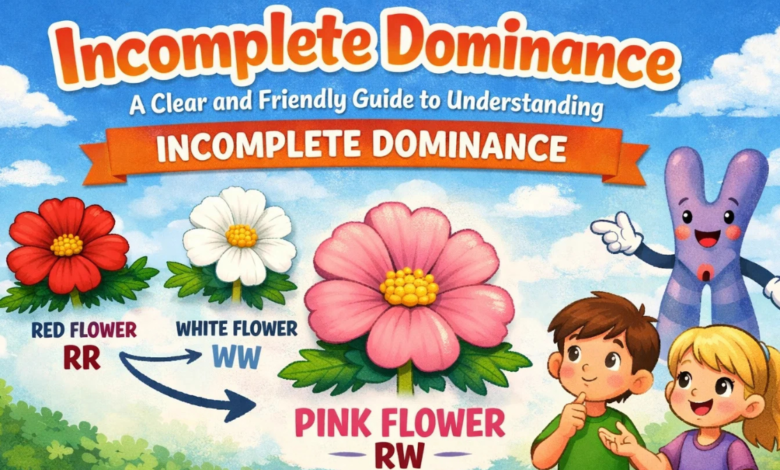
Incomplete dominance is one of those science ideas that sounds tricky at first, but once you break it down, it starts to make perfect sense. In simple words, happens when neither parent trait fully hides the other. Instead, the offspring shows a blended or intermediate trait.This fascinating pattern of inheritance helps explain why nature looks so colorful and diverse think pink flowers from red and white parents or animals with mixed coat shades.
In this detailed and easy-to-read article, we’ll explore step by step. Using clear examples, simple language, helpful tables, and friendly explanations, you’ll see how works, why it matters, and how it’s different from other inheritance patterns. By the end, you’ll feel confident explaining to anyone no sweat.
What Is Incomplete Dominance?
is a type of genetic inheritance where one allele does not completely dominate the other. As a result, the offspring shows a blend of traits from both parents.
To put it plainly:
- One trait does not overpower the other
- Both traits partially express themselves
- The result is a new, mixed appearance
For example, if one parent has red flowers and the other has white flowers, their offspring may have pink flowers. The pink color is not random it’s a clear sign of incomplete dominance.
This pattern is common in plants, animals, and even some human traits. It shows that genetics isn’t always an all-or-nothing game.
Why Incomplete Dominance Matters in Genetics
Understanding helps us see that inheritance is more flexible than we once thought. It teaches us that traits can mix and blend in predictable ways.
Here’s why incomplete dominance is important:
- It explains blended traits in nature
- It helps scientists predict offspring traits
- It supports plant and animal breeding
- It improves our understanding of genetic diversity
Without many natural colors, shapes, and sizes would be hard to explain. It fills in the gaps where simple dominant–recessive rules fall short.
The Basic Genetics Behind Incomplete Dominance
To understand , we need to talk briefly about genes and alleles.
- Genes are instructions for traits, like flower color or height
- Alleles are different versions of the same gene
- Each parent gives one allele to their offspring
In neither allele is strong enough to fully hide the other. Instead, both alleles influence the trait, creating a middle result.
Think of it like mixing paint:
- Red paint + White paint = Pink paint
That “pink” outcome is the genetic blend caused by.
Common Examples of Incomplete Dominance in Nature
Nature is full of great examples of, and some are surprisingly easy to spot.
Flower Color in Plants
One of the most famous examples of is found in snapdragon flowers:
- Red flower × White flower
- Offspring: Pink flowers
The pink color is not weak red or faded white. It’s a true blend, showing both traits equally.
Animal Coat Colors
Some animals show in coat color:
- Black-feathered parent × White-feathered parent
- Offspring: Gray or blue feathers
The mixed color helps animals adapt and survive in different environments.
Size and Shape Traits
In some plants, height or leaf size may show , resulting in offspring that are medium-sized compared to their parents.
How Incomplete Dominance Differs from Complete Dominance
Many people confuse incomplete dominance with complete dominance, but they’re not the same thing.
Here’s a simple comparison to clear things up:
| Feature | Incomplete Dominance | Complete Dominance |
|---|---|---|
| Trait expression | Blended | One trait fully shown |
| Offspring appearance | Intermediate | Same as dominant parent |
| Example result | Pink flowers | Red flowers only |
| Allele strength | Equal influence | One allele stronger |
In incomplete dominance, neither allele “wins.” Instead, they cooperate, creating something new.
Incomplete Dominance vs Codominance
Another common mix-up is between and codominance. They sound alike, but they work differently.
- Incomplete dominance: Traits blend
- Codominance: Both traits appear fully, side by side
For example:
- In incomplete dominance, red + white = pink
- In codominance, red and white both show clearly, like spots or stripes
Understanding this difference helps students and scientists avoid confusion when studying inheritance patterns.
Punnett Squares and Incomplete Dominance
A Punnett square is a simple chart used to predict offspring traits. It works beautifully with .
Let’s imagine:
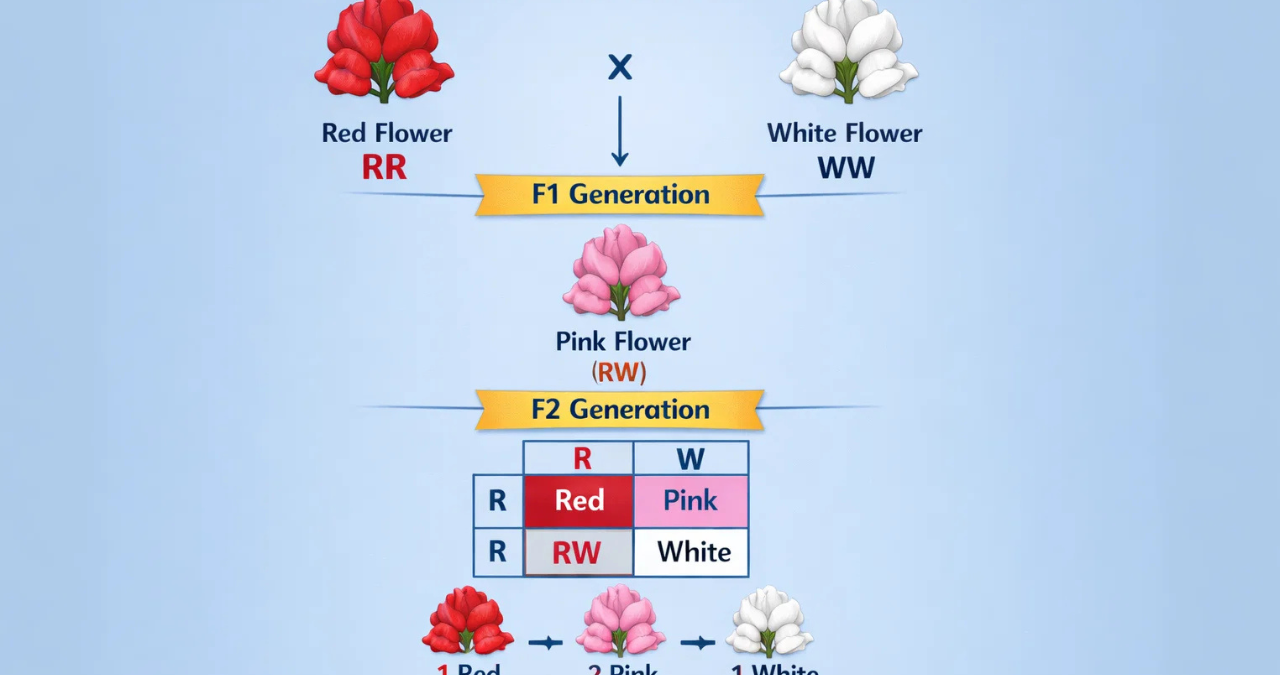
- One parent has red flowers (RR)
- One parent has white flowers (WW)
When we cross them:
- All offspring are RW
- RW results in pink flowers
This shows how creates uniform, blended traits in the first generation.
Punnett squares help:
- Predict trait outcomes
- Understand probability
- Visualize inheritance patterns
They’re a handy tool for learning and teaching incomplete dominance.
Incomplete Dominance in Real-Life Applications
Incomplete dominance isn’t just a classroom topic it has real-world uses that affect our daily lives.
Agriculture
Farmers use incomplete dominance to:
- Grow crops with improved color
- Develop plants with balanced traits
- Increase crop variety and beauty
Animal Breeding
Breeders study incomplete dominance to:
- Predict coat colors
- Improve animal health
- Create desired physical traits
Scientific Research
Scientists rely on incomplete dominance to:
- Study genetic disorders
- Understand evolution
- Explore trait inheritance
It’s safe to say plays a quiet but powerful role in science and society.
Common Misunderstandings About Incomplete Dominance
Even though is well-studied, some misunderstandings still pop up.
Here are a few myths cleared up:
- Myth: Blended traits are weak traits
- Truth: Blended traits are stable and predictable
- Myth: Incomplete dominance is rare
- Truth: It’s quite common in plants and animals
- Myth: It breaks genetic rules
- Truth: It follows genetic rules perfectly
Once you understand the basics, feels logical and reliable.
Why Students Should Learn About Incomplete Dominance
Learning about helps students:
- Think critically about genetics
- Appreciate biological diversity
- Build a strong science foundation
It also makes biology more exciting. Instead of memorizing facts, students see how traits mix and match in real life. That “aha!” moment is priceless.
Teachers love because it:
- Encourages curiosity
- Uses visual examples
- Connects science to nature
The Role of Incomplete Dominance in Evolution
Over time, can influence evolution by creating new trait variations. These variations may:
- Help organisms adapt
- Improve survival chances
- Increase genetic diversity
Blended traits can be beneficial in changing environments. That’s why is more than a simple concept it’s part of the bigger picture of life on Earth.
Key Characteristics of Incomplete Dominance
Let’s recap the main features of in a quick list:
- Neither allele is fully dominant
- Offspring show intermediate traits
- Traits blend, not disappear
- Results are predictable
- Common in plants and animals
Keeping these points in mind makes identifying much easier.
A Simple Way to Remember Incomplete Dominance
Here’s a handy tip:
Incomplete dominance = incomplete control
No allele has full control, so both share the spotlight. That shared influence creates the blended result we see.
Final Thoughts on Incomplete Dominance
Incomplete dominance is a beautiful reminder that genetics isn’t always black and white. Sometimes, it’s pink, gray, or somewhere in between. By understanding we gain a deeper appreciation for how traits are passed down and why living things look the way they do.
From colorful flowers to fascinating animal traits, shows us that nature loves balance and variety. It follows clear rules, yet produces endless outcomes. That’s the magic of genetics order and creativity working hand in hand.
As you move forward in your studies or simply explore science out of curiosity, keep in mind. It’s a small concept with a big impact, and once you understand it, you’ll see the natural world with fresh eyes.
You may also read
George Lucas Net Worth: A Complete, In-Depth, and Trustworthy Guide