Behind the Bastards: A Deep Dive into the Podcast That Exposes History’s Worst People
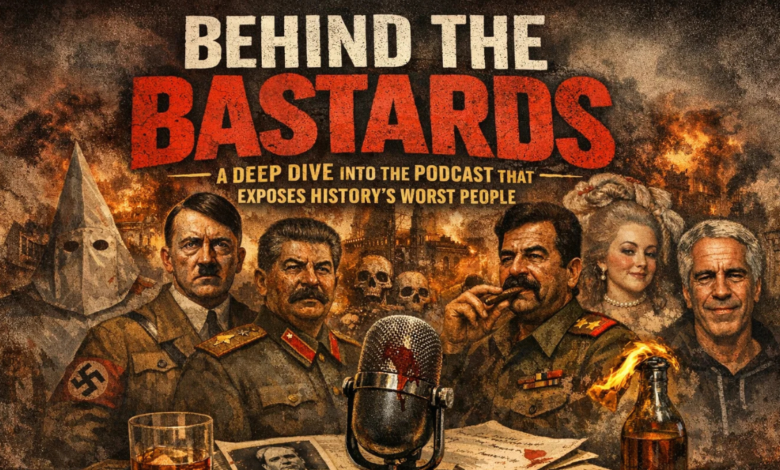
Behind the Bastards.What compels us to look into the abyss of human history? Why should we spend our time listening to the life stories of dictators, fraudsters, and genocidal maniacs? The explosive popularity of the podcast Behind the Bastards provides a compelling answer. Hosted by investigative journalist Robert Evans, this isn’t a show that glorifies evil. It’s a meticulous, darkly comedic, and deeply researched excavation project. It digs past the simplistic caricatures of “madmen” to reveal the systems, enablers, bizarre personal quirks, and societal failures that allow a bastard to rise to power. The journey behind the bastards is not about morbid curiosity; it’s an act of civic self-defense. By understanding the specific, often ridiculous, pathways to atrocity, we arm ourselves with the knowledge to spot the next one taking shape. This article serves as your definitive guide to the phenomenon, exploring its unique formula, its most shocking revelations, and the vital historical literacy it promotes in an age where the past feels dangerously present.


The Foundational Premise of the Show
The core mission of Behind the Bastards is to deconstruct the myth of the singular, omnipotent monster. Evans operates from the principle that no bastard operates in a vacuum. A tyrant needs bureaucrats, a con artist needs marks craving a solution, and a propagandist needs a society primed with fear. Each episode meticulously charts not just the life of its subject, but the fertile ground that allowed them to sprout. This approach reframes history from a series of inevitable events caused by “bad guys” to a complex web of contingencies, cowardice, and failed safeguards.
This focus on systems and complicity is what elevates the show beyond a biographical true-crime format. When exploring the rise of a figure like Hitler, the show spends significant time on the mundane political maneuvering of the Weimar Republic, the industrialists who backed him for profit, and the everyday citizens who chose accommodation over resistance. The lesson is clear: the bastards themselves are almost secondary. The real story lies in the societal architecture they exploit, an architecture we must learn to recognize and reinforce against future breaches.
The Distinctive Narrative Voice and Format
Robert Evans brings a unique and potent blend of journalistic rigor and gallows humor to the microphone. His background in conflict reporting and investigative work, including for outlets like Bellingcat, informs the show’s unflinching commitment to primary sources. He often reads directly from the bastard’s own writings, contemporary news clippings, or court transcripts, letting their own words damn them. This evidentiary foundation is crucial, transforming the narrative from opinion to documented fact, no matter how surreal those facts may be.
However, the presentation is far from a dry lecture. Evans consistently deploys a weary, sarcastic, and deeply humane commentary that serves as an emotional ballast for the heavy subject matter. The frequent use of guest co-hosts, often comedians or fellow journalists, creates a dynamic akin to a horrified book club. This structure allows for moments of necessary levity and real-time processing of the absurd or horrific information being presented. It makes the deeply unsettling content not just palatable, but engaging, creating a community of listeners who are learning to “look at the man behind the curtain” together.
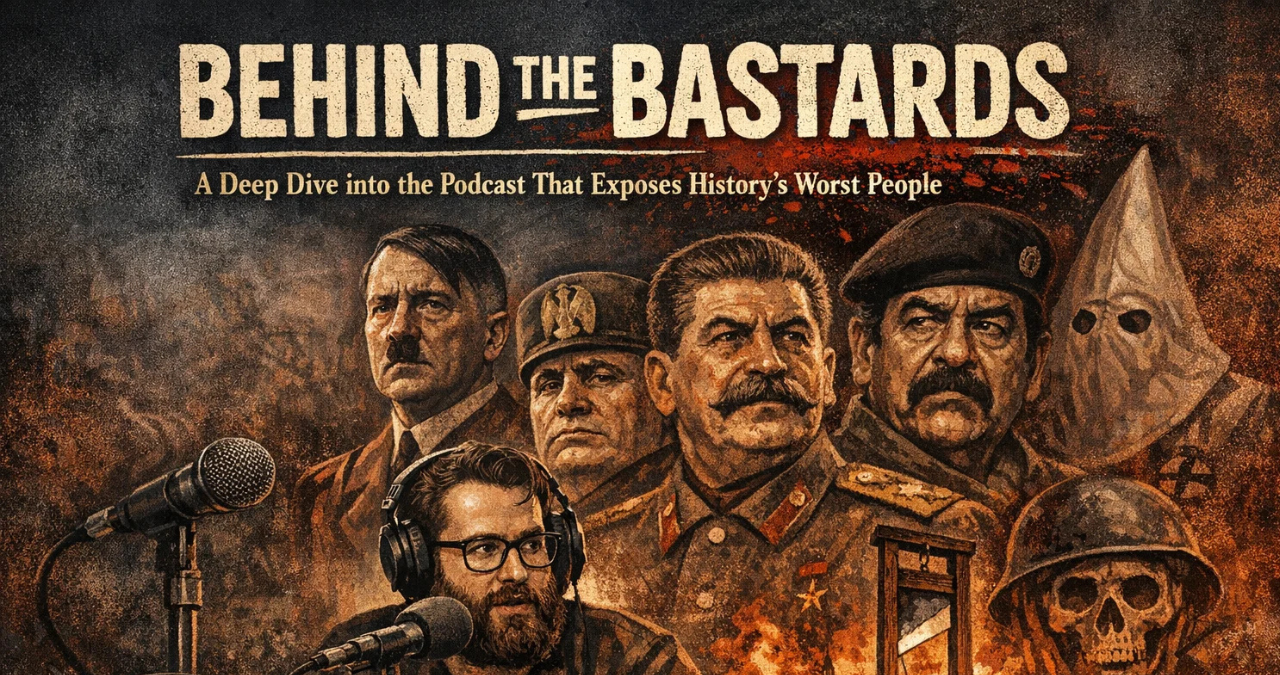
Deconstructing the Archetype of the Bastard
Behind the BastardsBehind the Bastards excels at taxonomizing evil, revealing that bastards come in several distinct, though often overlapping, models. The first is The Incompetent Grifter. These are figures like L. Ron Hubbard or Victor Lustig, whose initial success is built not on genius but on audacious confidence games and a keen understanding of human vulnerability. Their stories reveal how easily systems can be gamed by sheer bravado, and how the line between a cult leader and a CEO can be perilously thin. Their legacy is often one of chaotic, sprawling damage stemming from a base of pure selfishness.
Behind the Bastards The second, more dangerous model is The Ideological True Believer. Figures like Reinhard Heydrich or Pol Pot were not merely seeking wealth or status; they were ruthlessly implementing a warped ideological framework. The show’s analysis here focuses on the internal logic of these belief systems and the bureaucratic machinery required to enact them. Understanding this archetype is critical because it moves beyond the easy dismissal of “madness” and forces a confrontation with the fact that meticulously planned, industrial-scale horror is often perpetrated by people who are convinced of their own righteousness.
The Role of Enablers and Useful Idiots
No episode of Behind the Bastards is complete without a thorough audit of the supporting cast. The bastard is the lead actor, but the play cannot go on without stagehands, producers, and a willing audience. The show meticulously documents the Active Enablers: the bankers who launder money, the lawyers who find legal loopholes, the soldiers who follow illegal orders, and the journalists who parrot propaganda. These individuals often operate under a veneer of professionalism or duty, but their actions provide the essential infrastructure for atrocities.
Then there are the Passive Enablers, perhaps the most resonant category for a modern audience. This encompasses the vast population that chooses appeasement, willful ignorance, or “just following orders” out of fear, careerism, or a misguided sense of stability. The show repeatedly highlights moments where collective, courageous resistance could have halted a bastard’s rise, but did not materialize. This historical reflection serves as a direct, uncomfortable challenge to the listener: what are you ignoring or accommodating today for the sake of a quiet life?
Case Study Deep Dive: The Banal and the Bizarre
Behind the Bastards The power of Behind the Bastards is best illustrated through its episode selections, which often pair the world-historic with the inexplicably odd. A profound series on Joseph Stalin dissects the paranoid mechanics of a totalitarian state, showing how terror became a self-sustaining administrative tool. It’s a chilling lesson in how ideology can decay into pure power preservation, where the original revolutionary goals are utterly consumed by the machinery of control and murder.
In stark, almost surreal contrast, a multi-part series on Action Park—the notoriously dangerous 1980s New Jersey amusement park—explores a different kind of bastard: unregulated capitalism personified. Owner Gene Mulvihill’s disregard for safety, his manipulation of insurance law, and the cult of “fun” that excused blatant negligence creates a microcosm of systemic failure. It proves the show’s thesis that the mechanisms behind the bastards can operate anywhere, from the Politburo to a water slide, whenever accountability is dismantled and profit or power is prioritized over human well-being.
The Research Methodology and Source Integrity
Behind the Bastards What separates Behind the Bastards from less rigorous historical entertainment is its bedrock of research. Evans and his team prioritize primary sources: autobiographies, manifestos, declassified documents, and contemporary news reports. This “from the horse’s mouth” approach is vital. Listening to Evans read directly from Henry Kissinger’s memos or from the unhinged writings of cult leader Keith Raine provides an unmediated window into the subject’s mindset, stripping away later apologist interpretations.
Furthermore, the show consistently consults and cites the work of reputable historians, journalists, and experts. It doesn’t present itself as the final word, but as a compelling synthesis and narration of established scholarship for a broad audience. This commitment to source transparency builds immense trust with the listener. It signals that, despite the comedic tone, the facts are not being compromised for entertainment. The humor is in the reaction to the facts, not a replacement for them.
Impact and Cultural Resonance
The cultural footprint of Behind the Bastards extends far beyond podcast download charts. It has fostered a highly engaged, critically thinking community of listeners who apply the show’s analytical framework to current events. Discussions online often revolve around identifying modern “bastard-ready” systems or historical parallels to contemporary political figures. The show has democratized a form of systems-based critical analysis, providing its audience with the tools to question power structures and official narratives.
This impact is solidified by the show’s successful expansion into live tours, book projects, and a network of affiliated podcasts under the Cool Zone Media banner. It has proven that there is a massive, hungry audience for complex, dark history delivered with intelligence and wit. The show has moved the needle on public discourse, making it more acceptable—even necessary—to rigorously examine the worst of humanity to better defend our collective future. As Evans himself has noted, the goal is inoculation through education.
Common Misconceptions and Criticisms Addressed
A common superficial criticism of Behind the Bastards is that it monetizes or trivializes tragedy through comedy. This misunderstands the function of the humor. The comedy is almost never about the victims or the atrocities themselves. It is directed at the staggering hypocrisy, ineptitude, and absurd vanity of the perpetrators. It is a coping mechanism and a rhetorical tool to break down the intimidating, monolithic image of the bastard, making them appear as the flawed, often ridiculous humans they were. This demystification is a powerful step toward disempowering their legacy.
Another misconception is that the show focuses solely on distant, safely historical figures. While it covers many 20th-century icons, it consistently tackles contemporary bastards, from Elon Musk and Mark Zuckerberg to influential right-wing media figures and oligarchs. The analysis remains consistent: trace the money, expose the enabling systems, and highlight the human cost. The show argues that waiting for the “dust of history” to settle is a luxury we cannot afford; the analytical tools must be applied in real-time to those currently wielding destructive power.
The Educational Value and Civic Importance
At its heart, Behind the Bastards is a masterclass in applied history. It moves past names and dates to teach process and pattern recognition. Listeners don’t just learn what Stalin did; they learn how a person consolidates absolute power: through purging rivals, controlling information, creating external enemies, and bureaucratizing violence. This mechanistic understanding is far more valuable than memorizing timelines. It provides a diagnostic checklist for authoritarian behavior in any era.
This has direct civic utility. In an era of rising authoritarianism, misinformation, and demagoguery worldwide, the show functions as an early-warning system decoder ring. By making the past feel immediate and its processes explicit, it empowers listeners to identify rhetorical strategies, erosion of norms, and the grooming of enablers in their own political landscapes. The journey behind the bastards is, ultimately, a training exercise in vigilance. Knowledge of history is not about the past; it’s the only field manual we have for preserving a functional future.
Comparative Analysis: The Show’s Place in the Podcast Landscape
The podcasting world is rich with history and true-crime content, but Behind the Bastards occupies a distinct, hybrid niche. The table below illustrates how it differentiates itself from other popular formats.
| Podcast Genre / Example | Primary Focus | Narrative Tone | View of History | Behind the Bastards’ Differentiation |
|---|---|---|---|---|
| Narrative History (Hardcore History) | Epic, sweeping military/political events. | Cinematic, solemn, lecturer-as-storyteller. | Often “Great Man” theory; focused on pivotal events and leaders. | Focuses on systems & enablers, not just events. Uses comedy & explicit modern parallels. Rejects “greatness” framing. |
| True Crime (Casefile, Serial) | Solving a specific crime; psychology of an individual perpetrator. | Suspenseful, mysterious, often grim. | Micro-scale; forensic focus on one event/case. | Macro-scale; views individual “crime” as symptom of societal/power failures. Less “whodunit,” more “how was it allowed?” |
| Comedy History (The Dollop) | Highlighting absurd, forgotten stories from history. | Pure comedy duo; history as punchline setup. | History as a series of ridiculous anecdotes. | Comedy as relief valve, not the core product. Maintains rigorous sourcing and a central, serious argument about power. |
| Political Analysis (Pod Save America) | Current events, electoral politics, policy. | Persuasive, partisan, activist-oriented. | Focus on immediate present and near future. | Uses deep history to explain current political pathologies. Less “what’s happening” and more “why does this keep happening?” |
This positioning allows Behind the Bastards to appeal to listeners from multiple audiences—history buffs, political junkies, and true-crime fans—while delivering a unique synthesized product that challenges the conventions of each genre.
Ethical Considerations in Storytelling
Tackling stories of genocide, torture, and oppression carries a profound ethical weight that the show navigates with intentionality. A core tenet is centering the victims. While the bastard is the subject, the narrative consistently circles back to the human cost of their actions. Statistics are given names and stories where possible. This ensures the show never becomes a de facto celebration of the perpetrator’s “cleverness” or power, a pitfall of some lesser true-crime media.
Furthermore, the show is deliberate about sourcing and trigger warnings. Evans regularly provides explicit content warnings at the start of episodes dealing with sexual violence, child abuse, or graphic torture. This respects the listener’s autonomy and mental well-being. The commitment to primary sources also acts as an ethical guardrail; the horror described is not sensationalized invention but a report of documented reality. This combination of care for the audience and fidelity to the victims’ experiences establishes a moral framework that makes the difficult subject matter not just informative, but responsibly handled.
The Host’s Background and Authoritative Perspective
Robert Evans is not an academic historian, and this is arguably a strength of the show. His authority stems from a different sphere: frontline investigative and conflict journalism. His reporting from places like Ukraine and Syria, and his work with Bellingcat on open-source intelligence (OSINT), have given him a firsthand, ground-level understanding of how propaganda works, how violence escalates, and how states and non-state actors manipulate information. This lived experience with modern conflict zones infuses the historical analysis with a tangible, urgent relevance.
This background shapes the show’s preoccupations. He is particularly adept at dissecting the mechanics of propaganda, from Stalin’s show trials to the birth of modern talk radio with Rush Limbaugh. He understands media not as a passive backdrop, but as an active, weaponized tool in the bastard’s toolkit. His perspective is that of a practitioner who has seen the modern blueprints for atrocity and can recognize the historical prototypes. This lends the historical analysis a chilling, practical clarity that pure academic analysis sometimes lacks.
Listener Takeaways and Practical Applications
The ultimate value of Behind the Bastards lies in what the listener does with the information. The first major takeaway is cultivating a skepticism of power. The show is a multi-volume argument against taking any leader, CEO, or ideologue at their self-presentation. It teaches listeners to ask specific questions: Who benefits? Who is being scapegoated? What systems are being weakened? This skeptical mindset is the foundation of an engaged and resilient citizenry.
Secondly, the show provides a framework for analyzing current events. When a new political movement or tech mogul rises, a seasoned listener doesn’t just see the personality. They instinctively look for the enabling capital, the useful idiots in media, the exploitation of societal fears, and the testing of institutional guardrails. They understand that today’s bizarre, seemingly harmless grifter can be tomorrow’s authoritarian if the conditions are right. This transforms passive news consumption into an active analytical practice, which is the first step toward meaningful opposition or support.
The Legacy and Future of the Format
Behind the Bastards has already cemented its legacy as a paradigm-shifting show within podcasting. It proved that long-form, deeply researched, and challenging historical content could achieve mass popularity without dumbing down its subject matter. It pioneered a hybrid tone—simultaneously irreverent and deadly serious—that has influenced a wave of documentary and podcast storytelling. The show has effectively created a new sub-genre: the systems-analysis history comedy, focused on the pathology of power.
Looking forward, the show’s mission seems only more critical. As historical memory fades and misinformation ecosystems mature, the need for clear, engaging, and evidence-based deconstruction of dangerous individuals and movements grows exponentially. The show’s future likely holds deeper dives into the bastards of emerging threats—cyber-tyrants, algorithmic manipulators, and climate villains. The core question remains the same, and will as long as power exists: what lies behind the bastards of tomorrow, and what can we learn today to stop them?
Conclusion
Behind the Bastards is far more than a podcast; it is a public utility for the mind. By relentlessly pulling back the curtain on history’s worst actors, it performs the essential service of demystifying evil. It replaces the simplistic cartoon villain with a complex, disturbing, and often laughably pathetic human, surrounded by a cadre of enablers and a society that too often looked away. This process is not depressing, but paradoxically empowering. Understanding that bastards are made, not born, and that they require specific, identifiable conditions to thrive, means we can work to deny them those conditions.
The journey behind the bastards is ultimately a project of hope. It operates on the belief that an informed, skeptical, and morally engaged public is the strongest possible bulwark against the repeat of history’s greatest horrors. Robert Evans and his team have built a darkly hilarious, meticulously researched, and vitally important school of historical and political thought, one episode at a time. In giving us the tools to understand the past, they are providing us with our best chance to defend the future.
Frequently Asked Questions
Who is the host of Behind the Bastards?
The host is Robert Evans, an investigative journalist and writer with a background in conflict reporting and open-source intelligence (OSINT). His experience covering modern conflicts and propaganda heavily informs the show’s analytical lens, providing real-world urgency to the historical deep dives you encounter behind the bastards.
What makes Behind the Bastards different from other history podcasts?
The key difference is its systemic focus. While many history podcasts narrate events or explore biographies, Behind the Bastards is forensic in its examination of the enabling structures—the cowardly politicians, greedy financiers, and complacent publics—that allow a figure to cause mass harm. It pairs this rigorous, sourced research with a unique tone of gallows humor and conversational hosting.
Is the show only about historical figures, or does it cover modern subjects?
It covers both extensively. While it has deep series on figures like Hitler or Stalin, it consistently analyzes contemporary “bastards,” including tech billionaires, media moguls, and influential political operatives. The show argues that the analytical framework is just as critical for understanding active power players as it is for historical ones, which is a core reason to go behind the bastards of today.
How does the show handle such dark subject matter responsibly?
The show employs several ethical strategies. It provides clear content warnings for graphic material, centers the experiences and humanity of victims whenever possible, and uses humor to critique the perpetrator’s hypocrisy and absurdity, never the suffering they caused. The research is grounded in primary sources and expert scholarship, avoiding sensationalism.
Where can I start listening to Behind the Bastards?
New listeners can start almost anywhere with a subject that interests them. Popular entry points include the multi-part series on figures like Stalin, the rise of fascist movements, or the bizarre stories of con artists like John Brinkley. The show’s format is consistent, so jumping in with a compelling topic is the best way to experience its unique approach to getting behind the bastards.